How many nights this year have you actually looked up, on purpose, and not just glanced at the sky while carrying groceries inside?
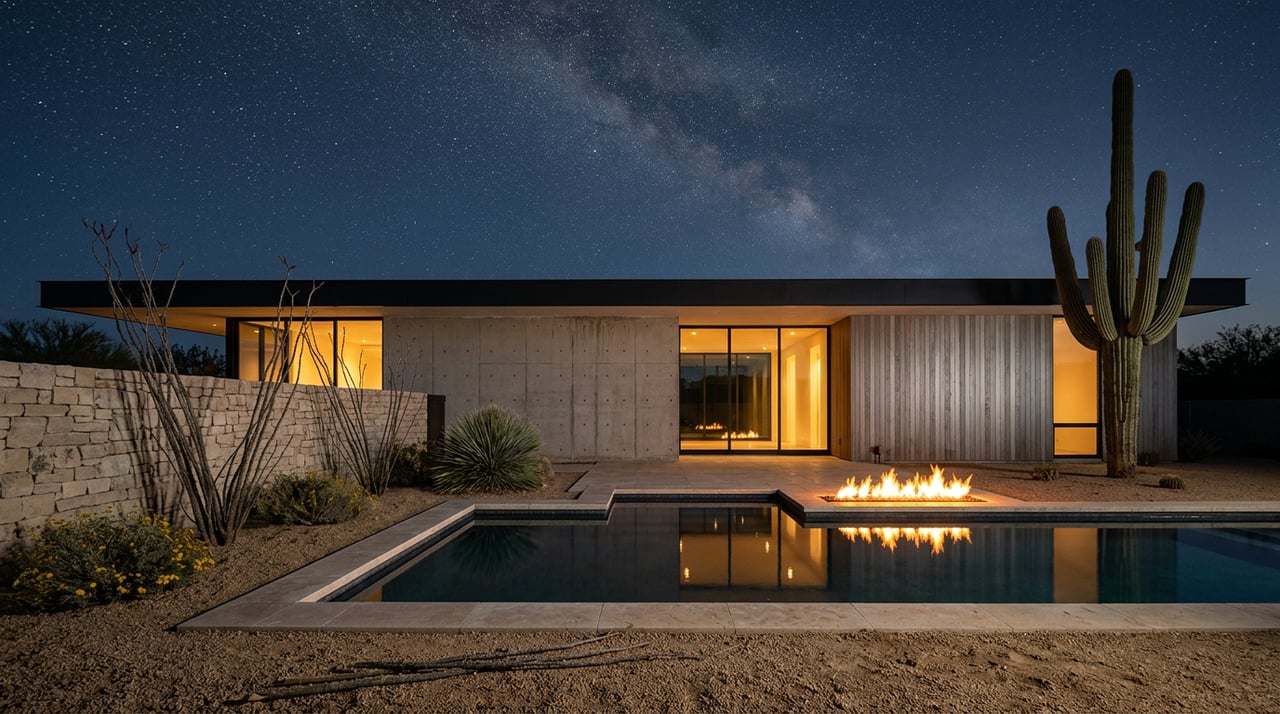
If you live in Fountain Hills, the honest answer is probably fewer than you'd guess. The town has carried its International Dark Sky Community designation since January 2018, when it became the 17th place in the world to earn that status. It shows up on the signs at the town entrances. It comes up when people from Phoenix ask why you moved out here. But for most residents, the actual experience of that designation has stayed pretty small: a folding chair in the backyard, maybe a glance at Orion on the walk from the car. That is about to change, and not in a symbolic way. A building is rising a few blocks from the library that turns the town's dark sky reputation into something you can walk into.
The Backyard Version Everyone Already Knows
The current, homegrown version of stargazing in Fountain Hills runs through the Fountain Hills Astronomy Club, a volunteer group founded in 2014 that now has more than 600 people on its mailing list. Members hold public star parties in Centennial Circle, the plaza behind the Fountain Hills Library and next to the Community Center, on a recurring schedule of Wednesday evenings through the cooler months. The Friends of the Library bring snacks and drinks. Club members bring telescopes. If you own one and want help learning to use it, someone there can walk you through it. If you don't, you just show up and look through theirs.
The library itself has quietly built one of the more unusual amenities in town: a set of telescopes, donated by a founding club member, that residents can check out like a book. That program earned the library a national award, which is a strange but fitting detail for a town of this size. It also tells you something about how long this has been a genuine community habit rather than a marketing line. People have been doing this here for over a decade, mostly unnoticed by anyone who wasn't already looking.
What's Rising a Few Blocks Away
The International Dark Sky Discovery Center broke ground in April 2024, timed deliberately to coincide with that year's total solar eclipse. It's a $25 million project, roughly 22,000 to 23,000 square feet, designed by SWABACK Architects + Planners and built by McCarthy Building Companies, the same firm that has worked on projects nationally for close to 160 years. When it opens, it will hold:
- A Dark Sky Observatory housing a 27.5-inch PlaneWave CDK700 telescope, the largest in metro Phoenix, research-grade and remotely operable, with planned access for students at Arizona State University and Maricopa Community Colleges as well as the general public
- The Craig and Ruth Gimbel Hyperspace Planetarium, a 65-seat dome that measures 39 feet across and 36 feet tall and weighs 38 tons, lifted into place by a one-million-pound crane in December 2024 while several hundred residents came out to watch
- A 150-seat multipurpose auditorium
- A Night Sky Experience exhibit hall focused on the relationship between dark skies and life on Earth
- Classroom space for the STEM education programs the center is being built around
That telescope detail matters more than it might sound like on first read. Right now, the biggest instrument most residents have ever looked through is one of the library's checkout scopes or something a fellow club member hauled out to Centennial Circle. The PlaneWave CDK700 is a different category of equipment entirely, the kind of telescope research institutions use, sitting inside a public building a short drive from Fountain Park.
The Timeline That Actually Matters
For most of the past two years, this project has been something residents watched from a distance, funded in stages through matching fund campaigns and covered mostly through construction-progress photos. That phase is over. Phase I, covering the building's exterior and roughly a third of its interior, wrapped in 2025. As of June 2026, Phase II is underway, which covers the planetarium build-out, the theater, the exhibit hall, classrooms, the kitchen, and interior finishes. According to the center's CEO, Dr. Cain Jagodzinski, construction is scheduled to be finished by the end of December 2026, with staff training and final setup carrying into the new year and a full public opening expected in early 2027.
That's a meaningfully different statement than "under construction," which is what this project has been for most of its life. This is now a building with a finish line residents can circle on a calendar.
The One Night You Can See It Before the Ribbon Cutting
You don't have to wait until 2027 to see what's inside. On Saturday, September 19, 2026, the Discovery Center's current site in downtown Fountain Hills will host International Observe the Moon Night, a free, NASA-sponsored global event, from 7:30 to 9:00 p.m. Visitors will get a chance to view the Moon's craters and ancient lava plains through the same telescope that will anchor the finished observatory. It's a preview, not a grand opening, but it's the closest thing to a walk-through the town has offered so far.
Why the Sky Actually Stays Dark Here
None of this works without the geography that made Fountain Hills a candidate for dark sky status in the first place. The McDowell Mountains sit between the town and the Phoenix skyglow, and protected and tribal lands to the north, south, and east keep development, and its accompanying light, from closing in. That combination is rare enough that Fountain Hills is one of only two International Dark Sky Communities located near a major metropolitan area anywhere in the world.
It's also rarer than the designation itself suggests. As Joe Bill, president of the Discovery Center's board, put it when describing why the project belongs here:
"We're kind of on the leading edge of a global movement to preserve the dark skies."
Bill has also noted that out of more than 200 designated dark sky places around the world, Fountain Hills is one of only 13 featured in the Smithsonian's "Lights Out" exhibit. That's a level of recognition most residents driving past the town entrance sign have no reason to know about.
What This Actually Changes for Someone Who Already Lives Here
The Wednesday night star parties at Centennial Circle aren't going anywhere. Neither is the library's telescope checkout program, or the annual Dark Sky Festival at the Community Center, which returned in March 2026 with astronaut Susan Kilrain, one of only three women to have piloted a NASA Space Shuttle, as its headline guest. Those grassroots traditions built the reputation the town now has, and they'll keep running after the Discovery Center opens.
What changes is what sits behind them. For over a decade, the town's dark sky status has lived mostly as an idea, a sign at the entrance, a talking point, a reason people give for moving here that's hard to point to physically. By early 2027, there will be an actual building to point to, with the largest telescope in metro Phoenix inside it. September 19 is the first night you can see a piece of that before it's finished.
If you already call Fountain Hills home, that's a good excuse for an evening out. If the idea of a town where the night sky is treated as civic infrastructure, not just scenery, is part of what draws you to a place, that's worth knowing too. Gregory Hidder + TEAM works with buyers and sellers across Fountain Hills and the surrounding Scottsdale and Paradise Valley communities, and we're always glad to talk about what makes a specific pocket of the desert worth calling home, dark skies included.